The verses people cite — quoted in full, not paraphrased
Four verses come up in nearly every comment section where someone posts their life path number. I've watched the same four get quoted at people, usually by someone who hasn't opened a Bible since a wedding, and usually without the verse before or after it. So let's put them on the table in full, no paraphrasing, before we argue about what they mean.
Deuteronomy 18:10-12 (NIV): "Let no one be found among you who sacrifices their son or daughter in the fire, who practices divination or sorcery, interprets omens, engages in witchcraft, or casts spells, or who is a medium or spiritist or who consults the dead. Anyone who does these things is detestable to the Lord."
Leviticus 19:26: "Do not eat any meat with the blood still in it. Do not practice divination or seek omens."
Isaiah 47:13: "All the counsel you have received has only worn you out! Let your astrologers come forward, those stargazers who make predictions month by month, let them save you from what is coming."
Those three are the skeptic's arsenal. The enthusiast's counter-verse is usually Revelation 13:18: "This calls for wisdom: let the person who has insight calculate the number of the beast, for it is the number of a man. That number is 666." People point to this and say, see, the Bible does math with numbers — therefore numerology is biblical. Both readings skip a step. Let's do the step.
What those passages actually prohibit: divination and prediction, not number symbolism
Deuteronomy 18:10-12 lists seven specific practices — child sacrifice, divination, sorcery, omen-reading, witchcraft, spell-casting, and necromancy through mediums. Every single one of them is a method for predicting or manipulating an outcome using an external sign: entrails, cast lots, the flight pattern of birds, a voice from the dead. None of them describe reducing a birth date to a single digit or converting the letters of a name into numbers. That's not a loophole I'm inventing to make a product look good — it's just what's in the list.
Here's the objection I'd raise if I were reading this skeptically: "You're splitting hairs. Divination is divination, whatever the tool." Fair. But the mechanism matters because the sin named in Deuteronomy 18 is specifically seeking hidden knowledge of the future from a source other than God — that's the through-line connecting omens, spells, and necromancy. Isaiah 47:13 makes the same point about Babylonian astrologers: the condemnation is aimed at people who "make predictions month by month" and claim those predictions will save you from disaster. That's a forecasting claim, and forecasting claims are exactly what a name-and-birthday calculation cannot honestly make.
This is also where I'll answer "is numerology a sin" directly instead of dodging it: if a practice is being used to predict your future or claim supernatural foreknowledge, most conservative readings of these verses would say yes, that's the divination Deuteronomy 18 names. If a practice is being used as a structured way to reflect on a pattern in your own name and dates — closer to journaling with arithmetic than to consulting a medium — it isn't the activity these verses describe. The verb matters more than the noun.
Where the Bible itself uses numbers symbolically: 7, 12, and 40
Numerology and the Bible actually overlap more than either side wants to admit, just not in the fortune-telling sense. The Bible uses specific numbers as recurring symbolic markers constantly, and this practice — using a number outside its plain arithmetic value to convey meaning — is documented well enough to have its own name: biblical numerology.
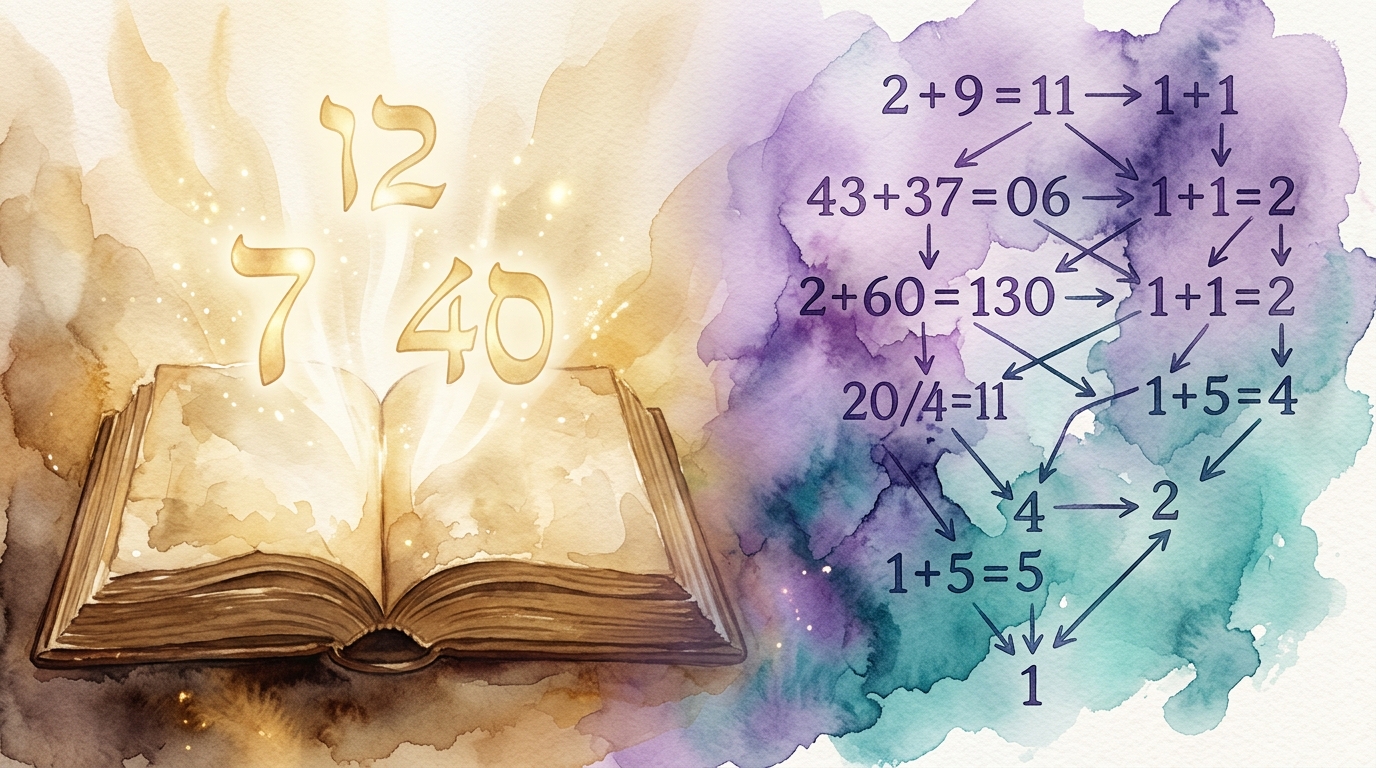
Three numbers do almost all the symbolic work in scripture: 7, 12, and 40.
7 shows up as the day God rested (Genesis 2:2-3), the number of times Naaman washes in the Jordan (2 Kings 5:14), and the number of seals, trumpets, and bowls structuring the entire book of Revelation. 12 is the number of tribes of Israel (Genesis 49) and the number of apostles Jesus names (Matthew 10:1-4) — a direct numeric echo connecting the old covenant's twelve tribes to the new covenant's twelve apostles. 40 appears as the number of days of rain in the flood (Genesis 7:12), the number of years Israel wandered the wilderness (Numbers 14:33), and the number of days Jesus fasted in the desert (Matthew 4:2).
None of that is coincidence math and none of it is fortune-telling. It's the text assigning weight to a number because of what happened around it repeatedly, then reusing that number later so the reader makes the connection. That's structurally the same move numerology makes when it says a life path 7 tends to cluster around introspection and solitary work — not a prediction, a pattern read after the fact. If you want to see how that pattern-reading actually plays out for a specific number, life path number meanings walks through all nine digits with the reduction shown.
The distinction that resolves it: self-reflection vs. fortune-telling
Here's the line I actually draw, and it's the same line I'd draw for a client sitting across from me asking if this is spiritually okay for them: divination predicts an outcome you couldn't otherwise know and asks you to act on that prediction. Self-reflection describes a pattern in information you already have and asks you to notice something about yourself. Those are different activities even when they both involve a number.
When someone calculates their life path number from a birth date they already know, or their destiny number from a name they've had their whole life, they're not learning a hidden fact about the future. They're running documented arithmetic — the Pythagorean letter-to-number conversion, digit reduction on a date — on data that was never secret. That's categorically closer to what a therapist does with a personality framework than what a medium does with a séance.
Where this breaks down, and where I think the skeptic's suspicion is completely earned, is any site or reading that says "this number means X will happen to you in March." That's a prediction claim, full stop, and it's the exact move Isaiah 47:13 calls out in the Babylonian astrologers. So the honest self-audit for any numerology tool is simple: does it describe a pattern, or does it promise an outcome? If your recurring 444 gets treated like a fortune-cookie prophecy, that's the fortune-telling. If it gets treated as a prompt — why is this number clustering around your current situation, and what's one thing to actually do about it this week — that's reflection. Angel number meanings is where we draw that line for the numbers people actually keep seeing.
And this is also where the Barnum effect objection deserves a straight answer instead of a dodge. If a reading is one number mapped to one paragraph, that paragraph has to be vague enough to fit millions of people born on that date — that's not divination, it's just bad design. The fix isn't mysticism, it's math: five numbers computed from your actual name and birth date, read against each other, produce combinations specific enough that a stranger's reading won't match yours. You can look up your own numbers and check the arithmetic yourself in under a minute, with no email required, which is the whole point of showing the conversion instead of asking you to trust it.
The honest answer, in two sentences
The Bible doesn't warn against number symbolism — it uses 7, 12, and 40 symbolically throughout its own text, and Deuteronomy 18 never mentions numbers at all. It warns against divination: claiming hidden knowledge of the future from omens, spells, or the dead, which makes numerology-as-self-reflection a different activity from numerology-as-fortune-telling, and any site promising you predictions is doing the thing the verses actually condemn, not the thing they don't mention.
Frequently asked questions
Is numerology a sin? It depends entirely on the verb, not the noun. Using numbers to predict a specific future outcome and acting on that prediction fits the divination Deuteronomy 18:10-12 names. Using numbers to reflect on a documented pattern in your own name and birth date — arithmetic, not prophecy — isn't the practice those verses describe.
Is numerology against Christianity? Christian traditions differ, and this is worth taking seriously rather than settling with a soundbite. What most conservative readings agree on is that the sin named in scripture is seeking hidden knowledge from a source other than God to predict the future — not the symbolic use of numbers, which the Bible itself does with 7, 12, and 40 throughout both testaments.
Does the Bible warn against numerology specifically? No verse names "numerology" or number symbolism as a sin. Deuteronomy 18 and Leviticus 19:26 name divination, sorcery, omen-reading, and consulting mediums — practices built around predicting outcomes from external signs, which is a different activity from reducing a name or birth date to a number for reflection. If you're curious how those calculations actually work, Chaldean vs. Pythagorean numerology shows two different systems producing two different numbers from the same name, math included.